Imagine a leadership style that feels as natural as breathing, yet is powerful enough to revolutionize your entire organization from its very core.
That’s the promise of conscious leadership.
Conscious leadership is the natural progression of effective management—a simple yet profound shift in perspective.
Conscious leadership takes the best of what you do and amplifies it, creating a ripple effect that touches every corner of your business ecosystem.
It’s not about learning a new language—it’s about fine-tuning the leadership voice you already possess.
But don’t just take our word for it.
Try it on. If you don’t see a marked improvement in your team’s engagement, decision-making quality, and overall organizational health within 90 days, we’ll eat our words.
That’s how confident we are in the transformative power of conscious leadership.
Every leader reflects on their actions. Conscious leadership simply deepens this innate practice.
It’s about asking, “How do my decisions affect not just the bottom line, but our people, our community, and our future?”
This expanded perspective doesn’t require new skills—it amplifies the introspection you already engage in.
Empathy
Imagine having a superpower that allows you to understand your customers deeply, motivate your employees effectively, and anticipate market trends accurately.
That’s empathy in the business world. It’s not about being ‘soft’—it’s about gaining razor-sharp insights for smarter decision-making.
Living Your Values
Integrity. Respect. Fairness. These aren’t just words on a company poster—they’re the principles that drew you to leadership.
Conscious leadership is about embodying these values more fully in your role. It’s the bridge between who you are and how you lead.
Expanded Responsibility
Leaders inherently feel responsible for their organization’s success.
Conscious leadership expands this sense of duty.
It’s about considering not just quarterly results, but the long-term impacts on all stakeholders.
This broader view doesn’t dilute your focus—it sharpens it.
Intuition
You’ve always trusted your gut.
Conscious leadership hones this instinct, combining it with broader awareness to guide you through complex decisions.
It’s about refining your most valuable internal tool.
Long-Term Thinking
In a world obsessed with quick wins, conscious leaders play the long game.
They consider all factors affecting business sustainability, from employee satisfaction to environmental impact.
This isn’t idealism—it’s smart strategy for lasting success.
Authenticity
Maintaining a ‘leadership persona’ is exhausting and inefficient.
Conscious leadership encourages authenticity, allowing you to lead more effectively by being genuine.
It’s about aligning your outer actions with your inner values, reducing the mental load of leadership.
Adaptability
In rapidly changing markets, adaptability is key to survival.
Conscious leadership enhances your ability to see change coming and respond proactively.
It’s about staying ahead of the curve, not just reacting to it.
Problem-Solving
Imagine solving problems with a full, panoramic view of the situation.
Conscious leadership provides this perspective, leading to more innovative and comprehensive solutions.
It’s about seeing opportunities where others see obstacles.
Legacy
Every leader wants to make a mark.
Conscious leadership is about creating a legacy that extends beyond financial success to positive societal impact.
It’s about being remembered not just for what you achieved, but for how you achieved it.
Stress Reduction
Counterintuitively, taking on a broader perspective can reduce stress.
Conscious leadership promotes better work-life integration and more meaningful engagement, leading to a more sustainable leadership approach.
Talent Magnet
In the war for talent, conscious leadership is your secret weapon.
It naturally creates the kind of workplace that attracts and retains top performers who are looking for more than just a paycheck.
Implementing Conscious Leadership?
Conscious leadership isn’t just about changing the content of our leadership—the specific decisions we make or the words we say.
It’s about restructuring the fundamental approach to leadership and creating a new framework.
By focusing on structure, conscious leadership aims for systemic change. It’s not about adding new content to an old system, but about creating a new system that inherently fosters consciousness in all aspects of leadership.
Imagine building a house. The structure is the foundation, walls, and roof—the basic framework that defines the shape and stability of the house.
The content is everything inside—the furniture, decor, and people living in it.
You need both for a complete home, but they serve different purposes.
Just as a house’s structure determines what can be built within it, the structure of leadership determines what kind of organizational culture and outcomes are possible.
Conscious leadership restructures leadership to create space for more holistic, aware, and impactful practices.
“We cannot solve our problems with the same thinking we used when we created them.” – Albert Einstein
He suggests that – to overcome challenges, we often need to change not just what we think (content), but how we think (structure).
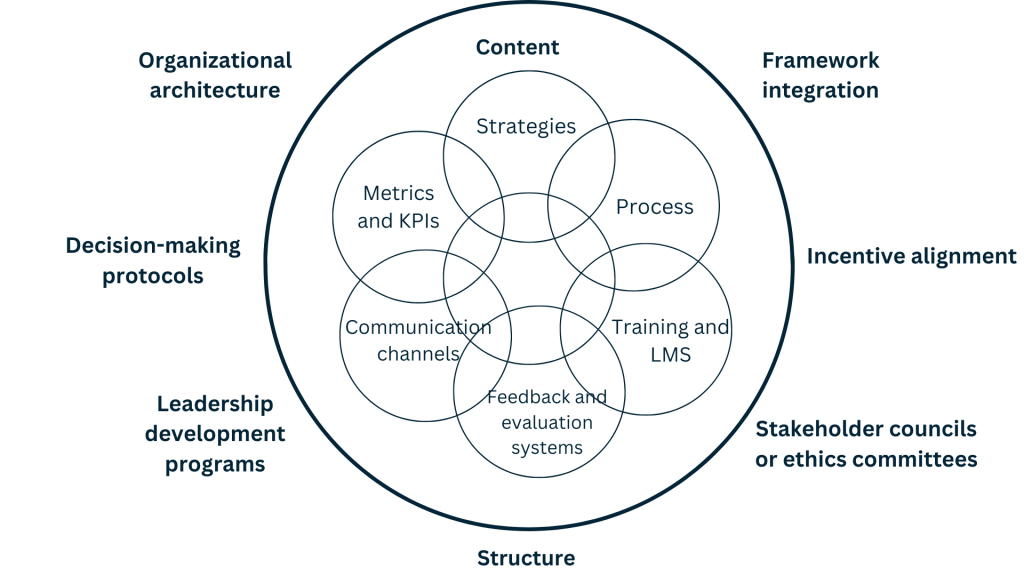
Changes At Structural and Content Level
Organizational architecture
Design an organizational structure that supports conscious leadership.
This could involve flattening hierarchies, creating cross-functional teams, or establishing roles specifically dedicated to promoting conscious practices.
Decision-making protocols
Develop structured decision-making processes that incorporate conscious leadership principles.
This might include checklists or frameworks that prompt leaders to consider broader impacts and stakeholder perspectives.
Leadership development programs
Create structured training programs that teach conscious leadership skills alongside traditional business competencies.
These programs could include modules on self-awareness, emotional intelligence, and systems thinking.
Feedback and evaluation systems
Implement 360-degree feedback systems that assess leaders on conscious leadership behaviors and outcomes.
This embeds conscious leadership into performance evaluation structures.
Governance models
Establish governance structures that support conscious leadership, such as stakeholder councils or ethics committees, to ensure multiple perspectives are considered in strategic decisions.
Incentive alignment
Develop compensation and promotion structures that reward conscious leadership behaviors and outcomes, aligning financial incentives with conscious practices.
Communication channels
Create formal channels for open dialogue, transparency, and collaborative problem-solving throughout the organization, supporting key aspects of conscious leadership.
Metrics and KPIs
Create measurable indicators for conscious leadership practices. This might include metrics for employee well-being, ethical decision-making, or stakeholder engagement.
By quantifying these aspects, you make conscious leadership more tangible and aligned with business-oriented thinking.
Here are a few practical metrics and KPIs that could be used to measure and promote conscious leadership practices:
Employee Well-being Index:
Employee satisfaction scores
Mental health days taken
Work-life balance ratings
Ethical Decision-Making Score:
Number of ethical dilemmas addressed transparently
Percentage of decisions that consider long-term stakeholder impacts
Frequency of ethics training completion
Stakeholder Engagement Metric:
Number of stakeholder feedback sessions held
Diversity of stakeholders involved in key decisions
Stakeholder satisfaction ratings
Environmental Impact Indicators:
Carbon footprint reduction
Waste reduction percentages
Sustainable resource usage rates
Social Responsibility Measures:
Community service hours per employee
Social impact investment as a percentage of profits
Number of partnerships with local community organizations
Inclusive Leadership Score:
Diversity in leadership positions
Employee perceptions of inclusivity
Number of mentorship programs for underrepresented groups
Transparency Index:
Frequency of company-wide communications
Openness about challenges and failures
Accessibility of leadership to employees
Innovation and Learning Metrics:
Number of employee-led innovation projects
Investment in employee skill development
Cross-functional collaboration rates
Purpose Alignment Score:
Employee understanding of company purpose
Alignment of individual goals with organizational purpose
Customer perception of company values
Conscious Culture Index:
Psychological safety scores
Employee turnover rates
Internal promotions vs. external hires
Long-term Value Creation:
Customer lifetime value
Employee retention rates
Sustainable growth metrics
Mindfulness and Self-awareness Measures:
Participation in mindfulness programs
Self-reported leadership self-awareness scores
360-degree feedback on leaders empathy and emotional intelligence
Conclusion
Conscious leadership isn’t a radical new concept—it’s the natural evolution of effective leadership.
Start Small: Begin with a pilot program focusing on a few key metrics. This approach allows for a gradual implementation and evaluation of the impact before scaling up.
Communicate Clearly: Ensure all employees understand what’s being measured and why.
Review Regularly: Set up quarterly review sessions to assess the effectiveness of the metrics and make adjustments as needed.
Link to Outcomes: Correlate these conscious leadership metrics with business outcomes to demonstrate their value.
It’s about expanding your awareness, living your values more fully, and considering the broader impact of your decisions.
In doing so, you not only become a more effective leader but also create a more resilient, innovative, and successful organization.
The question isn’t whether you can afford to embrace conscious leadership.
In today’s complex business landscape, the real question is: can you afford not to?

 ACTUALIZED LEADERS
Leave a comment